
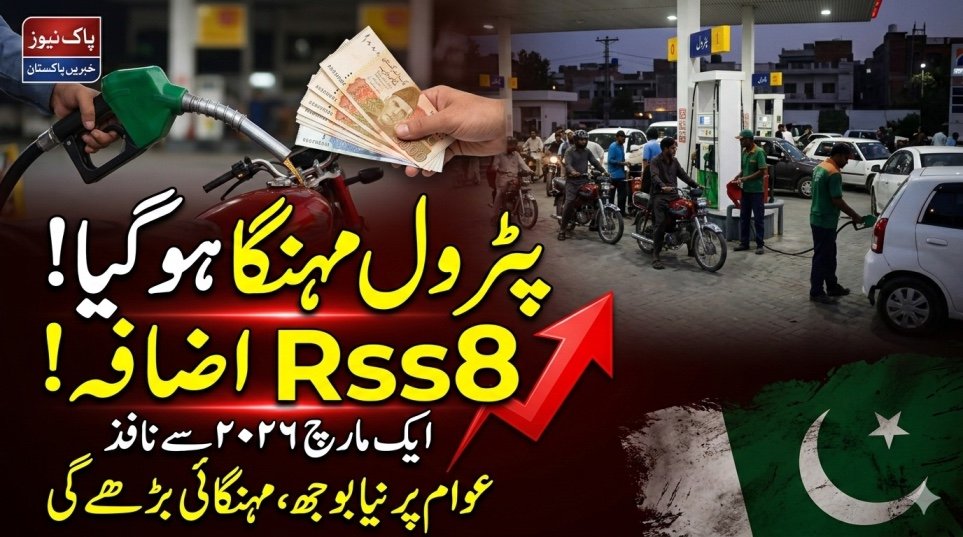
The federal government has increased the petrol price by Rs8 per litre for the next fortnight, effective from March 1, 2026. The decision was announced through an official notification late Friday night. This change will directly affect transport fares, daily commuting costs, and overall inflation across Pakistan. Citizens are now closely monitoring how this increase will impact essential goods and services in the coming weeks.
| Detail | Information |
| Price Increase | Rs8 per litre |
| Effective Date | March 1, 2026 |
| Duration | Next fortnight |
| Announced By | Federal Government |
| Notification Issued | February 28, 2026 |
| Impact Area | Nationwide |
| Affected Fuel | Petrol |
| Source | Official Government Notification |
Why Government Increased Petrol Price
The government revises petroleum prices every 15 days based on international market trends and exchange rate fluctuations. According to reports, global crude oil prices have increased, which has led to higher import costs for Pakistan.
- International crude oil price changes: Pakistan depends heavily on imported fuel.
- Exchange rate pressure: A weaker rupee increases import bills.
- Petroleum levy adjustments: Government revenue targets also affect pricing.
- Global supply dynamics: OPEC decisions and regional conflicts influence rates.
Officials state that the decision is based on recommendations from the Oil and Gas Regulatory Authority (OGRA).
New Petrol Prices Effective from March 1
Under the latest notification, petrol prices have been raised by Rs8 per litre for the next 15 days. The new rates are applicable nationwide starting March 1, 2026.
This update is part of the government’s regular fortnightly fuel price revision mechanism. Citizens are advised to check official updates through the Ministry of Finance website at Ministry of Finance Pakistan for authentic notifications.
The information in this article is based on the official government website and verified through top Google news sources covering the petroleum price update.
Impact on Public and Transport Sector
Petrol price hikes directly impact daily life. Transport fares are often revised shortly after fuel price increases. This means commuters may have to pay more for buses, rickshaws, and ride-hailing services.
- Transport fare adjustments: Bus and wagon fares may increase.
- Rise in goods transportation cost: Delivery charges could go up.
- Higher inflation pressure: Essential commodities may become more expensive.
- Household budget strain: Middle and lower-income families feel the biggest impact.
Small business owners, delivery riders, and daily wage earners are likely to face financial pressure due to higher operational costs.
How Petrol Prices Are Decided in Pakistan
Fuel prices in Pakistan are reviewed every fortnight. The government considers multiple factors before announcing new rates.
- OGRA recommendation submission.
- Review by the Ministry of Energy.
- Final approval by the Prime Minister.
- Official notification by the Finance Division.
This transparent mechanism ensures prices reflect international market conditions while maintaining government revenue targets.
Comparison with Previous Fortnight
In the previous fortnight, petrol prices remained stable. However, global crude oil prices showed upward movement in recent weeks. As a result, the government decided to increase rates by Rs8 per litre.
Analysts believe that if international oil prices continue to rise, further adjustments may be possible in the next review. However, if global prices stabilize, relief may be given in future announcements.
Public Reaction and Economic Concerns
The petrol price increase has triggered mixed reactions among citizens. Many people have expressed concern over rising living costs. Social media platforms are flooded with discussions about inflation and economic challenges.
- Concern over inflation: Prices of vegetables and groceries may rise.
- Demand for subsidy: Some citizens demand government relief measures.
- Business concerns: Transport and logistics sectors expect higher costs.
- Economic uncertainty: Households are adjusting monthly budgets.
Economic experts suggest that fuel price control is challenging due to Pakistan’s reliance on imported oil.
Helpline & Contact Information
For official updates and queries regarding petroleum pricing, citizens can contact relevant government departments.
Ministry of Finance Pakistan
Website: www.finance.gov.pk
Phone (UAN): +92-51-9202650
Oil and Gas Regulatory Authority (OGRA)
Website: www.ogra.org.pk
Phone: +92-51-9209288
These details are available on official government websites and verified through reliable Google sources. Citizens are encouraged to rely only on official platforms for accurate information.
Conclusion
The Rs8 per litre increase in petrol price effective from March 1, 2026, will have a direct impact on daily expenses, transportation, and overall inflation in Pakistan. While the government cites international oil prices and exchange rate pressures as key reasons, citizens are concerned about rising living costs. As fuel prices are reviewed every 15 days, the next fortnightly update will determine whether further increases or relief measures are announced. For accurate and timely updates, always check official government notifications.
FAQs
1. When did the new petrol prices become effective?
The new petrol prices became effective from March 1, 2026, for the next fortnight.
2. How much has petrol price increased?
The government has increased petrol prices by Rs8 per litre.
3. Who decides petrol prices in Pakistan?
Petrol prices are recommended by OGRA and approved by the federal government before official notification.
4. Where can I check official petrol price notifications?
You can visit the Ministry of Finance Pakistan’s official website for authentic and updated notifications.
More Recommended For You
 9999 PM Ramzan Relief Package 2026 CNIC Check Online – Complete Guide
 Petrol Price in Pakistan May Increase by Rs32 per Liter Before 15 March – Latest Update
 Petrol Shortage in Pakistan 2026 Raises Concern Across the Country
 Ramadan Gas Schedule 2026: Suhri and Iftar Timings Announced by Sui Southern
 Gold Price in Pakistan Drops After Global Gold Price Decline – Latest Gold Rate Update
 Today Update: BISP Taleemi Wazaif 50% Payment Increase 2026 – New Stipend Rates & Complete Apply Guide
 Today Update: BISP 8171 Payment 2026 Update – Check Rs. 13,500 Installment Online & via SMS
 Today Update: PM Ramzan Relief Package 2026 – New Registration Open for Non-BISP Families (Get Rs. 13,000 Cash)