
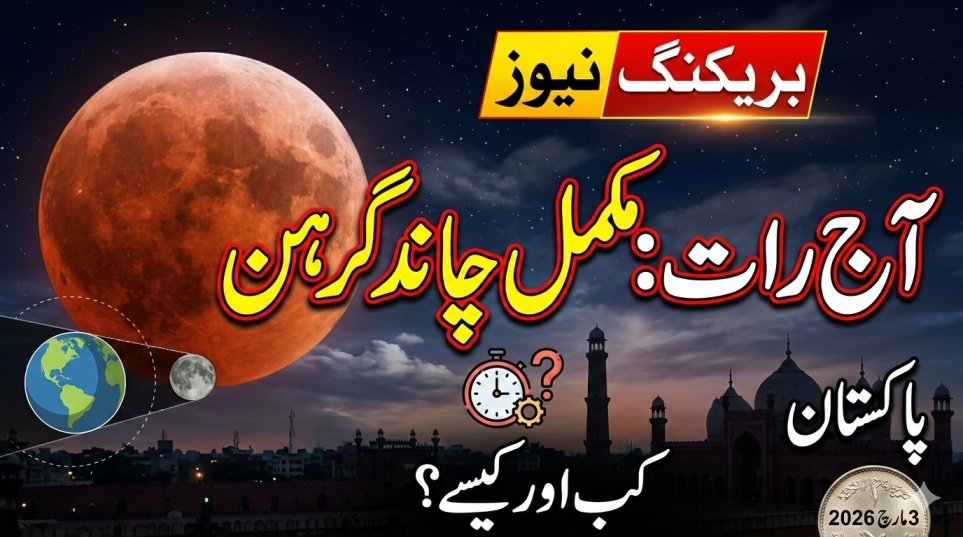
The first total lunar eclipse of 2026 will take place today and will be visible in Pakistan along with several other parts of the world. Skywatchers and astronomy enthusiasts are preparing to witness the celestial event, which will unfold in multiple phases throughout the afternoon and evening.
According to the Pakistan Meteorological Department (PMD), the eclipse will begin in the early afternoon and continue until night. However, in Pakistan, the Moon will rise while the eclipse is already in progress, meaning viewers will see it partially at moonrise.

Complete Lunar Eclipse Timings in Pakistan
Below is the full schedule of the eclipse phases in Pakistan Standard Time (PST):
| Phase | Time (PST) |
|---|---|
| Eclipse Begins | 1:44 PM |
| Partial Eclipse Starts | 2:50 PM |
| Total Eclipse Begins | 4:05 PM |
| Maximum Eclipse | 4:34 PM |
| Total Eclipse Ends | 5:03 PM |
| Partial Eclipse Ends | 6:17 PM |
| Eclipse Ends Completely | 7:23 PM |
The most significant stage, known as the maximum eclipse, will occur at 4:34 PM. During this time, the Moon will be fully immersed in Earth’s shadow.

Visibility in Pakistan
Although the eclipse starts earlier in the day, the Moon will rise in Pakistan while the eclipse is already underway. This means:
- The eclipse will be partially visible at moonrise
- The total phase may not be fully visible in some areas
- Clear weather conditions will be necessary for proper viewing
Experts suggest that people move to open areas with a clear eastern horizon to improve visibility chances.

Global Visibility Regions
The total lunar eclipse will not be limited to Pakistan. It will also be visible across multiple continents.
| Region | Visibility Status |
|---|---|
| Asia | Visible |
| Australia | Visible |
| North America | Visible |
| South America | Visible |
| Other Selected Regions | Partially Visible |
Different regions will experience the eclipse at different local times depending on their time zones.

What Happens During a Total Lunar Eclipse?
A total lunar eclipse occurs when:
- The Earth moves directly between the Sun and the Moon
- The Moon passes completely into Earth’s shadow
- Sunlight bends through Earth’s atmosphere and casts a reddish glow on the Moon
Because of this reddish appearance, a total lunar eclipse is often referred to as a “Blood Moon.” The red color is caused by light scattering through Earth’s atmosphere, similar to what happens during sunrise or sunset.
Is It Safe to Watch?
Unlike a solar eclipse, a lunar eclipse is completely safe to observe with the naked eye. No special glasses or equipment are required.
However, for a better experience, viewers can use:
- Binoculars
- A telescope
- A camera with zoom capabilities
Photography enthusiasts may capture dramatic images, especially during the maximum phase.
Why This Eclipse Is Important
This is the first total lunar eclipse of 2026, making it a notable astronomical event of the year. Such events attract attention from scientists, researchers, and the general public alike.
Astronomy experts recommend checking local weather forecasts before planning to observe the eclipse. Cloud cover may affect visibility in certain areas.
With favorable weather conditions, residents across Pakistan will have the opportunity to witness this rare and fascinating celestial phenomenon today.
More Recommended For You
 Government Increases Petrol and Diesel Prices by Rs55 Per Litre in Pakistan
 How To Apply For CM Punjab Agriculture Internship Program
 9999 PM Ramzan Relief Package 2026 CNIC Check Online – Complete Guide
 Petrol Price in Pakistan May Increase by Rs32 per Liter Before 15 March – Latest Update
 Petrol Shortage in Pakistan 2026 Raises Concern Across the Country
 Ramadan Gas Schedule 2026: Suhri and Iftar Timings Announced by Sui Southern
 Gold Price in Pakistan Drops After Global Gold Price Decline – Latest Gold Rate Update
 Today Update: BISP Taleemi Wazaif 50% Payment Increase 2026 – New Stipend Rates & Complete Apply Guide