
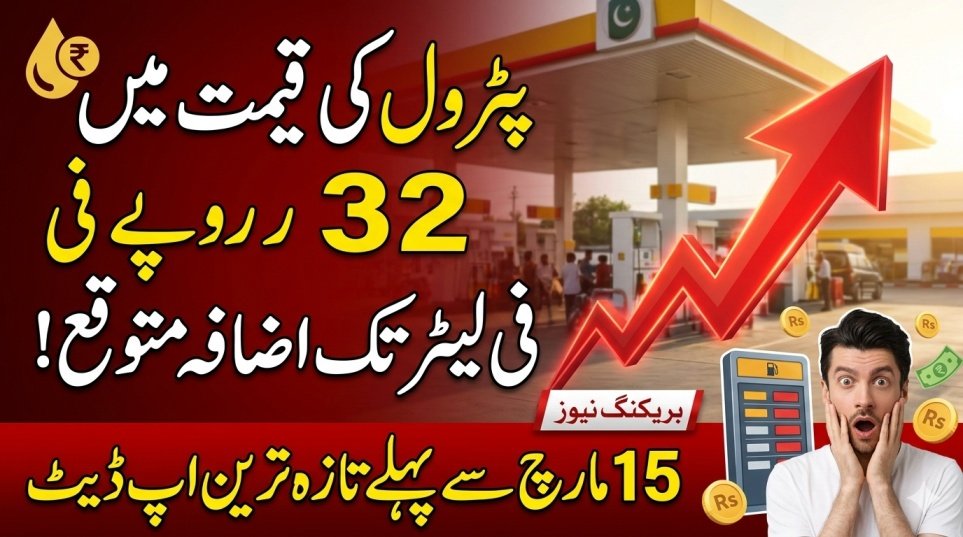
The petrol price in Pakistan may increase significantly before 15 March, according to recent discussions between government officials and international financial institutions. Reports suggest that the ex-refinery petrol price could rise by Rs32 per liter, which may directly affect consumers across the country. The possible petrol price increase in Pakistan is linked with global oil prices and economic reforms. Experts say the government may follow international pricing rules to maintain financial stability and meet economic targets.
| Key Factor | Details |
|---|---|
| Possible Increase | Up to Rs32 per liter |
| Expected Date | Before 15 March |
| Main Reason | Global oil price adjustments |
| Policy Pressure | International financial reforms |
| Impact | Higher fuel cost for consumers |
Petrol Price in Pakistan Expected to Increase Due to Global Oil Prices
The petrol price in Pakistan is closely connected with global oil prices, which continue to fluctuate. When international crude oil prices rise, the ex-refinery petrol price in Pakistan also increases. This change directly affects the retail petrol price for consumers.
Several factors are influencing the petrol price increase in Pakistan:
- Global crude oil prices have increased in recent weeks.
- Currency exchange rates also affect the petrol price in Pakistan.
- Import costs for petroleum products are rising.
- Government policies are aligned with international financial conditions.
- Economic reforms require adjustment in fuel pricing.
Because of these factors, experts believe the petrol price in Pakistan before 15 March may increase significantly.

IMF Recommendations on Petrol Price in Pakistan
The International Monetary Fund (IMF) has advised Pakistan to align the petrol price in Pakistan with international market rates. According to reports, the IMF suggested that the government should avoid providing subsidies on petroleum products.
Key recommendations regarding petrol price policy in Pakistan include:
- The government should not provide subsidies on petrol or diesel.
- Fuel prices should reflect global market conditions.
- Revenue targets should not be affected by price adjustments.
- The petroleum levy collection must continue according to fiscal targets.
More policy information related to energy pricing can be reviewed on the official government website: https://www.finance.gov.pk
These recommendations are part of broader economic reforms affecting the petrol price system in Pakistan.
Petroleum Levy Target and Petrol Price Impact
The petrol price in Pakistan is also influenced by the government’s petroleum development levy (PDL) targets. Authorities aim to collect significant revenue from this levy during the current fiscal year.
Important points regarding the petroleum levy and petrol price in Pakistan include:
- The government has set a revenue target of Rs1468 billion by 30 June.
- Around Rs822 billion has already been collected in the first six months.
- More than 60% of revenue was recorded between July and December.
- Maintaining this revenue target is essential for fiscal stability.
- Any subsidy on petrol could affect the revenue target.
Because of these financial goals, the petrol price increase in Pakistan may become unavoidable.
| Economic Indicator | Current Situation |
|---|---|
| Petroleum Levy Target | Rs1468 billion |
| Collected in First 6 Months | Rs822 billion |
| Revenue Period | July–December strong collection |
| Policy Objective | Maintain fiscal balance |
| Impact on Petrol Price | Higher fuel prices possible |

Government Measures to Control Economic Pressure
The government is also discussing additional measures to control economic pressure caused by the petrol price increase in Pakistan. These measures are designed to reduce fuel consumption and manage economic stability.
Possible policy actions being discussed include:
- Schools and colleges may shift to online classes to reduce fuel use.
- Universities may adopt smart working systems.
- Government offices could implement hybrid work models.
- Market and shop timings may be regulated.
- Grocery stores and restaurants may expand delivery services.
These steps aim to reduce energy consumption if the petrol price in Pakistan increases significantly.
Petrol Supply Situation in Pakistan
Despite concerns about the petrol price increase in Pakistan, officials say the country currently has sufficient petroleum reserves. This means there is no immediate risk of fuel shortages.
Key points about petrol supply in Pakistan include:
- National petroleum reserves are at satisfactory levels.
- Supply chains remain stable.
- Oil marketing companies continue regular distribution.
- No immediate fuel crisis is expected.
- Authorities are monitoring the situation closely.
Although supply remains stable, the petrol price in Pakistan may still increase because pricing is linked with international markets.
Petrol Price in Pakistan and Economic Stability
The discussion about the petrol price in Pakistan is part of broader negotiations regarding economic reforms and financial stability. Government officials are working to balance public affordability with fiscal responsibilities.
Economic experts believe the petrol price adjustment in Pakistan may be necessary to meet international financial commitments. These adjustments may help maintain budget targets and stabilize the national economy.
Conclusion
The petrol price in Pakistan may increase by up to Rs32 per liter before 15 March, mainly due to global oil price trends and economic policy reforms. International financial recommendations and government revenue targets are playing a major role in shaping the petrol pricing policy in Pakistan. While fuel supply remains stable, consumers may soon face higher fuel costs. The government continues to evaluate different strategies to balance economic stability and public impact related to the petrol price increase in Pakistan.
FAQS:
What is the expected petrol price increase in Pakistan?
Reports suggest the petrol price in Pakistan could increase by up to Rs32 per liter before 15 March.
Why is the petrol price increasing in Pakistan?
The petrol price in Pakistan may rise due to higher global oil prices, currency fluctuations, and economic policy adjustments.
Is there a petrol shortage expected in Pakistan?
No, officials say petroleum reserves in Pakistan are currently sufficient, and supply remains stable.
How does international policy affect petrol price in Pakistan?
International financial recommendations encourage Pakistan to align the petrol price in Pakistan with global market rates and reduce subsidies.
More Recommended For You
 9999 PM Ramzan Relief Package 2026 CNIC Check Online – Complete Guide
 Petrol Shortage in Pakistan 2026 Raises Concern Across the Country
 Ramadan Gas Schedule 2026: Suhri and Iftar Timings Announced by Sui Southern
 Gold Price in Pakistan Drops After Global Gold Price Decline – Latest Gold Rate Update
 Today Update: BISP Taleemi Wazaif 50% Payment Increase 2026 – New Stipend Rates & Complete Apply Guide
 Today Update: BISP 8171 Payment 2026 Update – Check Rs. 13,500 Installment Online & via SMS
 Today Update: PM Ramzan Relief Package 2026 – New Registration Open for Non-BISP Families (Get Rs. 13,000 Cash)
 Today Update: Withdraw 13000 Ramzan Package cash through JazzCash and Easypaisa